Monday, 28 March 2011

Nefertari: Hieroglyphs and Monuments


Hieroglyphs
The hieroglyphics in Queen Nefertari’s Tomb mostly compose of excerpts from the Book of the Dead, the Egyptian book of spells and rituals for the afterlife, as well as snippets explaining her life and her importance.  Her entire tomb is known as “House of Eternity”, eternity is important as it highlights her importance and her status in both life and death (McDonald, 1996: 8).  The hieroglyphs are in the tomb for both the visitor to the tomb, as well as to be a beacon for Queen Nefertari in the afterlife (McDonald, 1996: 6).  The hieroglyphs are created out of being lightly carved into plaster and when dried they were primed with gypsum; in her tomb there is 520-square meters of hieroglyphs (McDonald, 1996: 6). 

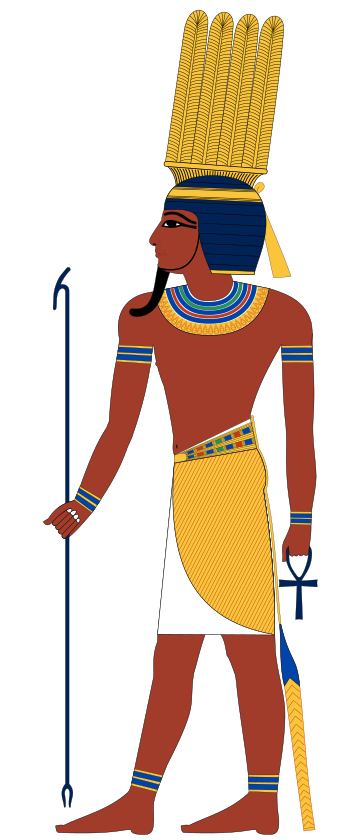
Though there are at least eight different chapters from the Book of the Dead written in Queen Nefertari’s tomb, chapter 17 is one of the more widely showcased texts within the tomb (McDonald, 1996: 57).  One important section of the hieroglyphs deals with Egyptian mythology pertaining to the Queen and both her past and future.  There is a part that explains the stories of the nine main Gods and Goddesses of Egypt.  The deities listed are Atum (finisher of worlds), Shu (personification of air), Tefnut (goddess of moisture, air and rain), Geb (personification of earth), Nut (personification of sky), Isis (goddess of motherhood, magic, and fertility), Osiris (God of the underworld and the afterlife), Nephthys (Goddess of night and lamentation), and Seth (Storms, Desert, and Chaos) all figure prominently into her tomb, the first generation listed is associated with the earth, while the second generation is associated with humans (McDonald, 1996:48-52).  The Queen herself was associated closely with the Goddess Mut, mother goddess who can be depicted as both a woman and a white vulture, who was an associated that she had since her birth, and later she became also associated with Hathor, also a mother goddess, possibly depicted as a cow, both powerful, beautiful, and domestic Goddesses of the Egyptian pantheon.  Throughout the tomb Nefertari is referenced to as “Osiris” which is both a great honor, putting her almost par with the Kings for status, and also means that she has completed the crucial step towards her quest for immortality (McDonald, 1996: 51).  


Figure 1: First Generation of deities-Atum, Shu, Tefnut, Geb, Nut


Figure 2: Second Generation of deities-Isis, Osiris, Nephthys, and Seth


  Figure 3: Mut and Hathor

  The writing in the Book of the Dead was created only using a male pronoun, so when there was a female that was chosen to have the same text written in her tomb as any King, some difficulties arose. 

 “Beginning of the praises and recitations to come forth and go down into the Necropolis, to be spiritualized in the Beautiful West, the coming forth by day in order to assume the forms amoung any he [sic] wishes, playing senet and sitting in the booth, coming forth as a living ba by the Osiris, the king’s great wife, mistress of the two lands,  Nefertari, beloved of Mut, justified after he [sic] died.  It is effective t do this on earth, so that it happens entirely according to instructions (Book of the Dead Chapter 17 [McDonald, 1996: 59]).”

The above quote is from the Book of the Dead, as translated in House of Eternity: Tomb of Nefertari.  The book suggests that the slip of pronoun my have been because of loss of concentration; it could be attributed to many different things (McDonald, 1996: 59).  The main point though of showcasing this quote is to exhibit, that Queen Nefertari was in fact granted almost equal rights to those of a man in ancient Egypt. 


Monuments

Queen Nefertari is special, in regards that she is one of the only Queens’ who gained a similar monumental legacy that, which the Kings of Ancient Egypt received.  Queen Nefertari has two monuments in devotion to her, which are listed in the texts and associated with her life and burial.    The first is her colossus, a huge statue of high status, in Luxor.  The second monument to her greatness is two 33 feet high colossus in the temple of Abu-Simbel.  This second monument is especially unique for a woman as it associates her with both the Goddess Mut and the Goddess Hathor (Lesko, 1991: 10).  Within the monuments of the time the women were portrayed as voluptuous and eternally youthful to stress immortality.  This association is a reflection of her involvement in religious ritual and state affairs in Egyptian life.  These also exhibit the fact that Queen Nefertari’s own legacy spans far further then just her tomb (McDonald, 1996: 16+17). 

Figure 4: Nefertari Colossus at Luxor  (above)              Figure 5: Nefertari Colossus at Abu-Simbel (bellow)

Discussion

 A direct comparison between the preparation of the bodies into the afterlife is impossible because the body of Nefertari was never found. However, it is assumed that the preparations of her body would be similar to that of Ramesses' because she was his wife, and Queen, rendering her of high status. Therefore, they would have had to make sure she was properly prepared for the afterlife. Her preparation was never stated specifically, but we can infer that her organs were removed and placed in canopic jars prior to her body being wrapped in layers of linen. In Ancient Egyptian society, females were thought to not have a role in rebirth, so in order to be reborn in the afterlife they had to undergo a gender change during the mummification process. This gender change was brought about through the artwork on her sarcophagus.  In comparing the grave goods and sarcophagus of Ramesses II and Nefertari was difficult as in Ramesses II’s tomb only his sarcophagus was left, the material was calcite whereas the material which is thought to be pink granite.  We are unaware at this point whether there was any symbolic importance in the type of stone used. However we are unable to compare the grave goods as both were robbed in antiquity, although several objects were left behind in Nefertari’s tomb.

When comparing the artwork in the tombs of Ramesses II and Nefertari, there are a few main difficulties.  First of all, the tomb of Ramesses II had been excessively flooded, washing away most evidence of painted artwork on the walls.  The tomb of Nefertari is covered in meaningful artwork designed to aid her on her journey to the afterlife.  The tomb of Ramesses II lacks paintings, but there are interesting carvings in the walls.  The engravings in the wall of the Ramesses II chamber relate mostly to his family, notably one engraving of Nefertari.  The one thing the two have in common are the idea that they are both buried alongside meaningful imagery that was designed to help smooth the way for the journey into the afterlife. 

Comparing the hieroglyphs in Queen Nefertari's Tomb to Ramesses II's tomb, there is an apparent difference between the two.  There is an absence of hieroglyphs in Ramesses II's tomb due to to numerous floodings.  While Queen Nefertari's Tomb has an abundance of beautiful hieroglyphic vingettes and quotes from the Book of the Dead.  I hypothesize that if there were to still be present hieroglyphs within Ramesses II's tomb, they would be almost identical to the text found in Queen Nefertari's tomb.  This is because, the texts used to adorn Queen Nefertari's tomb are usually used only for the tombs of those of the male sex.  Because of Queen Nefertari's great status she was granted almost the same rights as any king.  With regards to monuments comparison, while we are aware there are monuments pertaining to Ramesses II and we have certainly illustrated Queen Nefertari's own monumental legacy, Ramesses II's monuments were not discussed in detail.

Conclusion

In conclusion, while we were unable to come to any concrete differences between the graves of Ramesses II and Nefertari, we did find that a woman's gender had to under go a metamorphosis to a more masculine or androgynous persona to be reborn in the after life. Therefore, a woman had to be represented as a male through her sarcophagus, and not showing evidence of children or husbands anywhere within the tomb.  We found that Ramesses II, being male, was given great care to assist his journey to the afterlife.  However, due to the Queen's ascribed status we can infer that her treatment would have been similar to that of the Pharoh.  There were some blunders, but he was wrapped and preserved with great care, and his unique profile was made eternal through the unique process of filling his nasal cavity with peppercorns, seeds, and small animal bones. 

  When looking at the tomb of Ramesses II, even though the archaeological findings from his tomb are scarce, it is obvious that the people he ruled over worked very hard to ensure that his passage to the afterlife would be peaceful and successful.  Based on the remains found in the archaeological record in the tombs of Ramesses II and his favorite wife Nefertari, we are able to infer that the people they ruled over wished to ensure that they had a smooth transition into the afterlife and that regardless of gender they were viewed as important.

References

Benderitter, Thierry, translated by Hirst, Jon, The tomb of Nefertari Merytmut QV66. Available from <http://www.osirisnet.net/tombes/pharaons/nefertari/e_nefertari_01.htm>. [March 6, 2011].

Cooney, Kathlyn M 2008. ‘The Problem of Female Rebirth in New Kingdom Egypt: the fragmentation of the female individual in her funerary equipment.’  In Sex and Gender In Ancient Egypt, eds Carolyn Graves-Brown, The Classical Press Of Wales, Swansea. pp. 1-25.

Feldtkeller, E., Lemmel, E.M., Russell, A.S. 2002. Ankylosing Spondylitis in the Pharaohs of Ancient Egypt. Reumatology International. 23 (1) pp. 1-5.


http://en.wikipedia.org/wiki/Nut_%28goddess%29


 Fitzgerald, S. 2009. Ramses II: Egyptian Pharaoh, Warrior, and Builder. 1 ed. Compass Point Books.


Lesko, B.S. 1991, "Women's Monumental Mark on Ancient Egypt", vol. Vol.54, no. 1, pp. 4-15.


McCarthy, H.L. & McCarthy, H. 2002, "The Osiris Nefertari: A Case Study of Decorum, Gender, and Regeneration", Journal of the American Research Center in Egypt, vol. 39, pp. 173-195.


McDonald, J.K. 1996, House of eternity : the tomb of Nefertari, Getty Conservation Institute and J. Paul Getty Museum, Los Angeles, Calif.

  
Michael C. Carlos Museum. “Ramesses” [online] available at http://www.carlos.emory.edu/RAMESSES/3_mummification.html [March 25th , 2011].

Moreland, J. 2001, Archaeology and text, Duckworth, London. 

Ramses II- S.Fitzgerald, pgs: 88-91

R.Freed et al – U. Of Michigan, Ramses II

The Fakebusters Egyptian Antiques 2010.  Accessed March 28, 2011 http://www.thefakebusters.com/burial%20masks/real%20Egyptian%20burial%20masks%201.htm